The reality of beauty blogging today: navigating AI, algorithms and the relentless product churn

There was a time when running an independent beauty blog followed a relatively straightforward, satisfying course. You bought or received a product, put it through its paces over a fortnight or two, photographed the packaging on a clean windowsill and wrote a thorough, 800-word review. If your insight was genuine and your post was properly formatted, readers found you. Search engines delivered steady, organic traffic and readers occasionally left thoughtful comments at the bottom of the page.
Today, that landscape feels almost unrecognisable. The steady ground beneath independent digital publishers has shifted into a fast-moving, algorithmic mosaic of instantaneous AI snapshots, hyper-speed micro-video feeds and relentless product launches. For those running self-hosted blogs (just like this one) without massive commercial backing, simply keeping up can feel like running a marathon in sand.
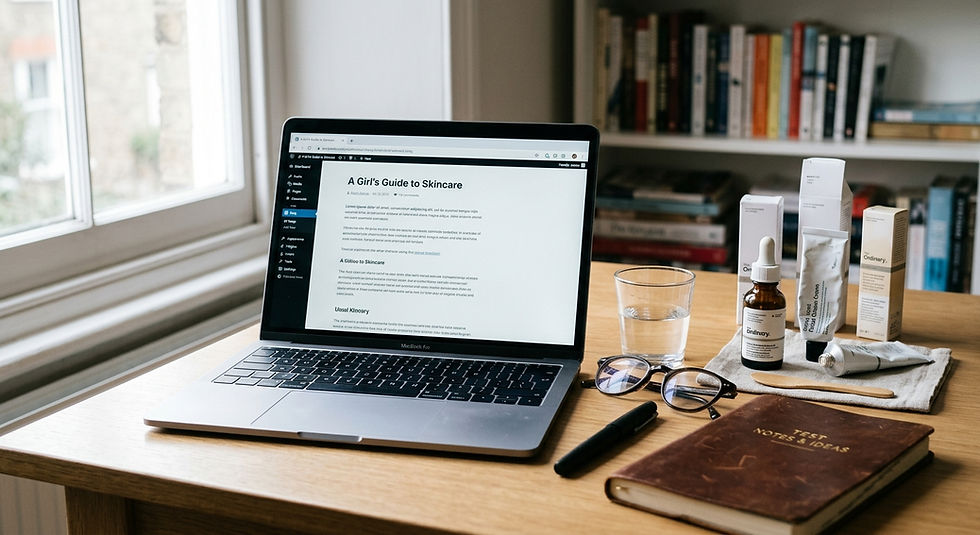
Yet, despite the noise, many of us continue to plug away. This post takes a frank look at the modern hurdles facing independent beauty bloggers today, the hidden shifts quietening organic traffic and why the written, independent voice remains more necessary than ever.
I’ve written this post to ‘reach’ those who may feel their tiny speck of space on the web has an ‘end’ date. If you’re considering calling it a day, you may want to understand the challenges first and decide where to go from there.
The following sections explain how visitors have been diverted away from traditional beauty blogs but also why the independent voice still matters.
Video-first: the rise of micro-vlogging
The dominant mode of beauty consumption has shifted firmly away from the written word to short-form video. Platforms like TikTok, Instagram Reels and YouTube Shorts have reconditioned how audiences interact with cosmetics and skincare.
That’s not to say all beauty vloggers are successful. However, some of the most trusted are not those with a million followers. Increasingly, micro vloggers with an audience of 10,000 upwards are cultivating loyal fan bases who value honesty above hype. They’d rather get their beauty fix from the ‘girl next door’ who can pull off a standout transformation than a sickly-sweet influencer who’s clearly doing everything with pound and dollar signs in their eyes.
If you don’t have the confidence to stick yourself in front of a camera, or simply don’t want to put yourself out there, writing down your views on a product or broader beauty topic can be just as satisfying — you just might not reach as many people.
So, here’s why beauty vlogging, as opposed to beauty blogging, has taken off…
Today’s consumers demand instant visuals. Yes, you can provide the eye candy on a blog, but it might not have the same impact. Audiences are looking for a 15-second visual confirmation — a quick swatch that shows a product’s shade in real-time use, a dramatic transformational swipe of mascara, or a glowing skin finish — rather than a structured, multi-paragraph analysis. Of course, there’s nothing stopping you from adding a video swatch to your blog, so you can offer your audience the best of both worlds on a predominantly written platform.
Online audiences are also favouring entertainment over evaluation. Micro-vlogging excels at immediate sensory gratification, but it inherently struggles with depth. A fast-paced video rarely has space to discuss formula stability, subtle pH dependencies, long-term skin barrier health, or how a product behaves after eight hours of wear under office lighting. Brevity is favoured over accuracy, leaving thorough written evaluation in the background.
I’ve had training in video production and editing. Back in the early 2000s, provincial newspapers were being told: ‘Video is the future.' Of course, that was right. However, hollowed out local newspaper companies, reeling from a steady decline in ad revenues, quickly realised that, other than the odd 30 second point-and-shoot footage of a fire or some other on-the-spot spectacle, video production is extremely time-consuming. It’s why most now largely rely on reader-submitted video.
My trip up the M5 probably cost my employers a pretty penny. Yes, I went on to produce video vox pops, interviews and all sorts. But it’s not something I see very often these days. The sheer wait for a video to upload to the web was the final blow (for me anyway). I recall an editorial assistant being stuck in the newsroom until some god-awful hour, waiting for a ‘breaking news’ video to finally go ‘live’. I feel for vloggers who go through lengthy processes for very few views.
Search engine shifts: AI Answers and zero-click discovery
Search engines have undergone their most aggressive evolution in two decades, changing how readers seek information online. For beauty blogging, it’s been the game-changer nobody wanted. The traffic is down, the engagement is down… In fact, everything is down. Without a constant stream of relevant new content, beauty blogs can suffer a catastrophic loss of visitors and ranking.
The instant AI summary on the likes of Google have taken some of the blame. They deliver a synthesization of answers at the top of the screen, obscuring independent voices. When a user searches for a straightforward query — such as how to layer specific actives or whether a particular botanical oil suits acne-prone skin — an AI-generated summary answers them instantly. The user gets their solution without ever needing to click through to a website, creating a culture of ‘zero-click’ searches.
Long-term, I can't see the benefit for search engines — not even with a pivot towards better ad targetting within a conversational space. AI takes its answers from other websites, some of which may have been built on paid search advertising. Often, the 'answers' are wrong. It pushes 'spenders' out of the frame and penalises the very businesses that have contributed to the platform's success. Then there's the prospect of legal action from major publishers and a potential shift away from ringfencing ad revenue for search engine campaigns.
Where's the long-term finacial incentive for AI Answers? AI is an expensive technology. Will ad revnue make it wortwhile in this context? If businesses turn their backs on AI positioned, search-related ads, weary of the constant changes and aware of a cynical public, would you subscribe to a search engine? I wouldn't.
Then there’s something we will call ‘algorithmic bias’ that, from what I’ve witnessed, tends to lean towards scale. Broad search engine updates designed to reward authority often favour massive legacy media outlets, corporate brand blogs, or high-authority aggregator sites. Independent niche publications, regardless of their subject expertise or first-hand testing rigor, often find themselves pushed further down the ranking page. It’s hard to beat that kind of competition.
Another massive issue is social media platform ‘walled gardens’. It used to be easy to drive traffic to a website… Simply post an intriguing paragraph with an original image on Facebook and instruct followers to ‘get the full story’ by clicking a link to your blog. It doesn’t work anymore. Driving traffic from social media to a standalone website has become a relentless battle. Social networks actively penalise posts containing external links, throttling their distribution to keep users inside their own digital ecosystems; the walled garden.
And let’s not forget, social platforms - just like newspapers - aren’t providing a public service; they are, first and foremost, businesses. They want you to spend cash to convert followers into website visitors. If you manage a blog that isn’t monetised, it’s not worth it. What if your site is monetised? Advertising your beauty blog could be money down the drain without careful research and testing.

The financial churn of beauty blogging
The sheer pace of the modern beauty industry has created a stark divide between heavily backed creators and independent voices.
The launch cycle has increased massively. Monthly, not seasonal, drops are now the norm. For the dedicated beauty blogger, it can mean new collections, reformulations and trend-driven products coming online weekly. This creates an artificial expectation that reviewers must cover every new launch immediately to remain relevant. In reality, bloggers simply can’t afford to keep up. It’s why many now focus on evergreen, general topics rather than individual products or collections. On this blog, you will find product reviews only on the items I purchase as and when they are required.
Micro influencers are in the same boat. I’ve lost count of the number of beauty commentators who have publicly drawn a line in the sand and stated they can’t afford to keep up. Some have put a stop to spending altogether. I’ve even witnessed top beauty vloggers sticking mere brand images of products on the screen and running through their opinions based on product descriptions alone. They can make or break a launch without so much as touching a single product.
Large-scale influencers on top-tier PR lists receive full collections weeks before launch at no cost. They can produce immediate content without financial outlay. That leaves traditional, independent beauty blogging at a significant disadvantage. Bloggers are going to be nowhere near ‘first’ to share their experience and, if and when they do, they will be out of pocket. It’s not lost on me that brands have come to expect a certain number of sales to ‘lower tier’ reviewers.
For an independent blogger who purchases products out of pocket, trying to keep pace with the churn is financially impossible. I must add that, in the case of skincare products, true evaluation requires four to six weeks of consistent use; rushing out a review in forty-eight hours just to capture trend traffic compromises editorial integrity.
What else is quietly draining organic views?
If you have noticed a quiet decline in your site analytics despite maintaining high content standards, several underlying factors are likely contributing. They include evolving search habits. A good example is that younger audiences increasingly bypass traditional search boxes entirely, turning to social video feeds or forum communities like Reddit as their primary search tools for product feedback.
Then there’s launch fatigue and saturation. The internet is over-run with derivative, repetitive beauty commentary. Audiences are experiencing product fatigue, resulting in lower overall search volume for newly released beauty lines.
It’s also worth noting that stricter browser privacy protocols, mandatory cookie consent banners and the widespread use of ad-blockers mean that a noticeable portion of your real readership may no longer register in standard analytics tracking.
Why independent, written beauty blogging still matters
Despite the structural hurdles, independent, written beauty blogs possess core strengths that fast video feeds and automated summaries cannot replicate: nuance, authority and true permanence.
For example, skincare is deeply personal and biological. Short videos rarely capture the subtleties of ingredient interactions, formulation textures, or long-term barrier repair. The written word remains the best format for nuanced, educational commentary.
Building an audience exclusively on a social media platform means building on rented land. In a nutshell: you will never own it or be able to control it. Algorithms change, accounts can be restricted and platforms fade. A self-hosted blog is an asset you own and control entirely.
Readers are becoming cynical about hyper-polished, sponsored video content. They're even casting a critical eye over the deliberately unpoliished ones. An independent creator who buys their own products, tests them methodically and offers uncompromised feedback builds a level of trust that money cannot buy.
Practical strategies for the long haul
To survive and thrive in this new landscape, independent beauty bloggers must pivot away from competing with high-speed churn and focus on their natural strengths.
These days, I try to avoid product roundups like ‘Best Serums for Dry Skin’ which are dominated by corporate publishers. Instead, I focus on specific, highly intent queries that focus on individual ingredients and how they can fit into and benefit a skincare routine. Of course, I still write about new products, but they are dictated by my personal preferences and budget.
I’ve been advised to remove poor-performing posts from my blog. There are a lot of them; I’ve been beauty blogging for years. I have posts with in excess of 10,000 views and others with under 20. Pruning back isn’t on my agenda right now. Beauty is like fashion; trends come and go. Just because something I wrote a month ago hasn’t garnered any traction doesn’t mean it won’t at some point in the future. If this website was monetised, yes, I’d definitely go for it. However, it isn’t (my choice as it is approved for Google monetisation).
I do have loyal readers who subscribe to my twice-monthly newsletter. While a good way of bypassing the limitations of social media, I note even they now have to be optimised in the same way as blog posts. While experts will tell you to grow your newsletter subscription list, there’s no easy way to do it if site visits are on the downward trend. I find the odd incentive, like a giveaway, helps.
I’ve turned multi-week product testing into a clear selling point. I often update a blog post until the ‘bottom of the jar’. Examples include my reviews of a Byoma eye cream and Super Facialists’ cleansing oil. By doing so, I’ve positioned my blog as a space for deliberate, thorough evaluation rather than instant, superficial impressions.
Blogging today is hard. Plugging away at an independent blog in the current digital climate requires patience, resilience and genuine passion for the craft. While the metrics may fluctuate and the algorithms will undoubtedly shift again, the demand for authentic, well-researched and honest writing hasn't vanished — it has simply become more discerning. By stepping off the hamster wheel of rapid product churn and focusing on depth, independence and long-term value, written beauty blogging can remain a deeply rewarding and essential space.
I started this blog during treatment for a rare breast cancer. I’ve had an entirely different breast cancer since then. Through it all, looking and feeling good thanks to beauty products has been what’s spurred me on. I believe in beauty, but I’m never going to lie about it. That’s why you can trust me to tell the truth about my experiences.


Comments