The ultimate guide to post-summer skin recovery: how to repair sun damage

The end of summer brings cooler weather, but it often leaves behind a hidden souvenir: sun-damaged skin. Months of exposure to UV radiation, elevated heat, humidity, air conditioning, and swimming pool chemicals can leave your skin barrier compromised, dehydrated and uneven in tone. Think you don’t need post-summer skin recovery advice?

As European summers become progressively hotter and heatwaves more prolonged, the seasonal toll on our skin is noticeably increasing. Addressing summer skin damage is no longer just about soothing a temporary sunburn; it requires a targeted, structured recovery strategy to repair structural integrity and rebuild resilience before winter arrives. Before you consider how to repair sun damage, first take in just how much damage has been done.
What summer actually does to your skin
To effectively repair post-summer skin, you first need to understand the distinct biological damage caused by seasonal environmental stressors.
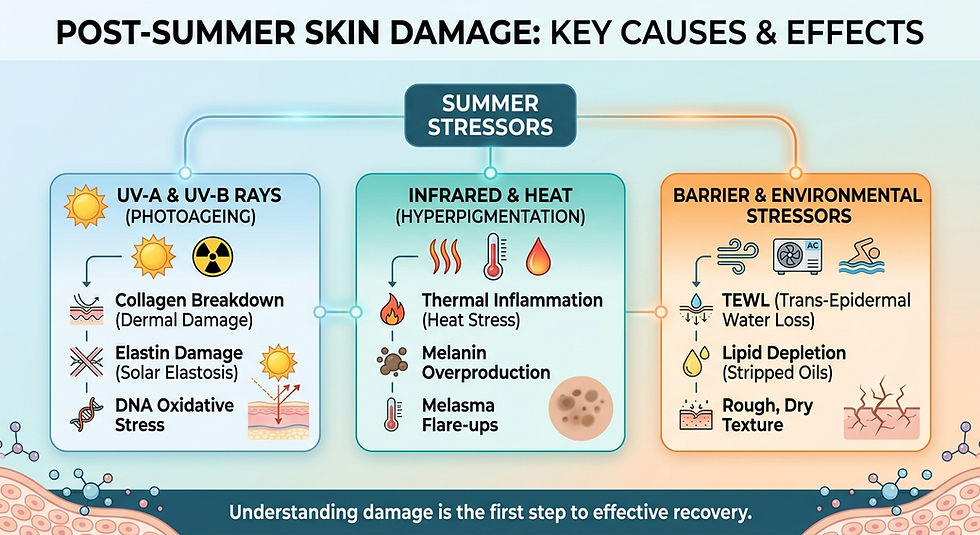
Photoageing: UV rays and structural collapse
Ultraviolet (UV) radiation is the leading external cause of premature skin ageing.
UV-A (ageing rays): These long wavelengths penetrate deep into the dermis. They generate reactive oxygen species (ROS), leading to oxidative stress that degrades collagen fibres and damages elastin. Over time, this causes solar elastosis—where elastin fibres become thickened, tangled, and non-functional, leading to deep wrinkles and sagging.
UV-B (burning rays): These shorter wavelengths hit the epidermis, directly damaging cellular DNA. This triggers the classic inflammatory response known as sunburn, accelerating skin cell turnover and leaving the surface rough, peeling, and compromised.
Heat, thermal stress and hyperpigmentation
UV light is not the only offender; ambient heat itself affects the skin.
Thermal inflammation: Elevated temperatures increase skin microcirculation and raise internal skin temperature, triggering inflammatory cascades.
Melanocyte reactivation: Thermal stress stimulates melanocytes (the pigment-producing cells) independently of UV radiation. This is why individuals with melasma or post-inflammatory hyperpigmentation (PIH) often notice darkening spots after summer, even if they were diligent with sunscreen.
Barrier breakdown and trans-epidermal water loss
Summer activities disrupt the skin's protective lipid mantle:
Air conditioning: Rapid shifts between hot outdoor air and cold, dehumidified indoor spaces strip moisture from the stratum corneum.
Chlorine and saltwater: Chlorine oxidises skin lipids, while ocean salt draws water out of skin cells through osmosis.
Sweat and sebum oxidation: Excess sweat mixed with oxidized surface lipids disrupts the skin microbiome, creating a habitat for congestion and micro-inflammation.
The result is increased Trans-Epidermal Water Loss (TEWL) — something we’ve mentioned before on this blog and a state where the skin loses moisture faster than it can replenish it, leaving it parched, reactive and dull.
The post-summer skin recovery assessment
Before jumping into treatments, assess the specific primary damage your skin sustained over the summer months.
Primary Concern | Key Signs & Symptoms | Primary Target Mechanism |
Barrier Degradation | Stinging on product application, tightness, flaking, red patches. | Rebuild intercellular lipids (ceramides, cholesterol, fatty acids). |
Epidermal Dehydration | Fine criss-cross lines, dullness, loss of plumpness despite oiliness. | Restore Natural Moisturising Factors (NMFs) and humectant reserves. |
Solar Hyperpigmentation | Sun spots, lentigines, uneven skin tone, darkening melasma patches. | Inhibit tyrosinase enzyme and block melanosome transfer. |
Structural Laxity | Coarsened skin texture, loss of bounce, deepening static lines. | Stimulate collagen synthesis and accelerate cellular turnover. |
The 4-phase post-summer recovery blueprint
Restoring skin requires a phased approach. Actives like high-strength acids or retinoids will only cause further irritation if applied to a compromised skin barrier.

Phase 1: Rebuilding the barrier and deep hydration (weeks 1–2)
Your primary objective during the first fortnight is stopping Trans-Epidermal Water Loss and calming sub-clinical inflammation.
Pause aggressive actives: Temporarily set aside strong L-ascorbic acid serums, high-percentage glycolic acids and prescription retinoids if your skin feels sensitive or tight.
Replenish bio-identical lipids: Look for barrier formulations containing the golden ratio of lipids: 3:1:1 (Ceramides, Cholesterol, Free Fatty Acids). This mimics the skin’s natural lipid matrix, repairing gaps between corneal cells.
Layer multi-molecular humectants: Hydration must reach different depths of the epidermis:
High molecular weight hyaluronic acid hydrates the surface.
Low molecular weight hyaluronic acid or polyglutamic acid penetrates deeper layers to hold water within the tissue.
Glycerin and Beta-Glucan soothe micro-irritation while attracting water.
Phase 2: Gentle exfoliation and resurfacing (weeks 3–4)
Once stinging subsides and barrier integrity is restored, clear away the accumulation of dead, sun-damaged skin cells.
Switch to polyhydroxy acids (PHAs): Instead of harsh physical scrubs or high-concentration alpha-hydroxy acids (AHAs), introduce PHAs like Gluconolactone or Lactobionic Acid. PHAs have larger molecular structures, meaning they penetrate the skin more slowly without triggering inflammation, while acting as humectants.
Targeted enzymatic exfoliation: Enzymatic treatments using papain or bromelain digest keratin proteins in dead surface cells without disturbing underlying living tissue.
Phase 3: Correcting hyperpigmentation and sun spots (weeks 5+)
With dead cell buildup cleared, apply active ingredients designed to fade UV-induced pigmentation and regulate melanin production.
Tyrosinase inhibitors: Tyrosinase is the key enzyme responsible for melanin production. Block its pathway using:
Alpha arbutin (2%): A gentle hydroquinone derivative that fades dark spots without irritation.
Tranexamic acid (3–5%): Highly effective for heat-induced pigment and melasma by inhibiting the interaction between keratinocytes and melanocytes.
Kojic acid and azelaic acid (10–15%): Ideal for fading post-inflammatory marks while soothing lingering redness.
Inhibit pigment transfer with niacinamide (4–5%): Niacinamide prevents the transfer of melanosomes (pigment packets) from melanocytes into surrounding skin cells, preventing new spots from surfacing.
Phase 4: Structural repair and collagen synthesis
To address collagen degradation caused by UV-A exposure, reintroduce structural repair agents into your evening routine.
Retinoids (Retinaldehyde or Tretinoin): Retinoids increase cell turnover and signal fibroblasts to synthesize new collagen. Prefer Retinaldehyde over standard retinol for faster conversion into retinoic acid with lower irritation potential.
Signal and carrier peptides: Pair retinoids with copper peptides or signal peptides (like Palmitoyl Tripeptide-1) to support skin repair and encourage structural firmness.
Expert practical tips for post-Summer care
To accelerate skin recovery, incorporate these practical adjustments into your daily routine:
Adopt the ‘moist-skin’ application technique: Apply humectant serums (hyaluronic acid, glycerin) to damp skin immediately after cleansing or misting. Applying humectants to dry skin in dry environments can draw moisture out of deeper layers.
Switch to a non-foaming cleanser: Swap out summer gel or foaming cleansers for nourishing cream, balm, or milk formulations. These clean the skin without stripping essential lipids.
Use thermal mists with caution: If using thermal spring water mists to cool down or hydrate, always seal the moisture in with a light moisturizer or facial oil immediately afterward. Allowing water mist to evaporate naturally off dry skin accelerates evaporation and worsens dehydration.
Targeted night masks: Replace your standard night cream twice a week with an occlusive overnight recovery mask containing squalane, centella asiatica (cica), or panthenol (Vitamin B5) to lock in hydration during peak circadian repair hours.
Continue broad-spectrum sun protection: UV-A levels remain significant throughout autumn and winter and penetrate through clouds and glass. Continuing daily application of broad-spectrum SPF 30 or higher is essential to protect newly revealed, vulnerable skin cells from recurring damage.
Daily recovery routine framework
Here is a balanced morning and evening routine structured specifically for post-summer skin restoration:

Morning routine: protect and hydrate
Cleanse: Wash with cool water or a gentle, non-foaming cream cleanser.
Hydrate: Mist skin with a soothing toner containing Centella Asiatica, Panthenol, or Rosewater.
Treat: Apply a light antioxidant serum combining 10% Vitamin C (Tetrahexyldecyl Ascorbate or L-Ascorbic Acid) with Vitamin E and Ferulic Acid to neutralise ongoing environmental free radicals.
Moisturise: Apply a barrier-repairing moisturiser featuring ceramides and squalane.
Protect: Finish with a generous layer of broad-spectrum SPF 30 or SPF 50.
Evening routine: repair and regenerate
Double cleanse: First, use a cleansing balm or oil to break down SPF, sweat, and pollution. Follow with a gentle hydrating cleanser.
Target: On alternate nights, apply your active treatments:
Night A: Retinoid (Retinaldehyde) to stimulate collagen synthesis.
Night B: Brightening serum (Tranexamic Acid + Alpha Arbutin) to fade pigmentation.
Seal: Apply a rich lipid-replenishing moisturiser containing ceramides, fatty acids, and cholesterol to lock in active ingredients and support overnight repair.
Long-term outlook
Post-summer skin recovery is a gradual process that requires patience. While epidermal hydration can improve within days, addressing deep-seated photoageing, collagen degradation, and hyperpigmentation takes six to twelve weeks of consistent care — aligning with full cellular turnover cycles.
By stepping back from harsh treatments, rebuilding your skin's natural lipid barrier and systematically fading excess pigment, you can successfully repair summer damage and enter the colder months with resilient, radiant and healthy skin.
This article is intended for informational puroses only and is no substitute for qualified medical advice.


Comments